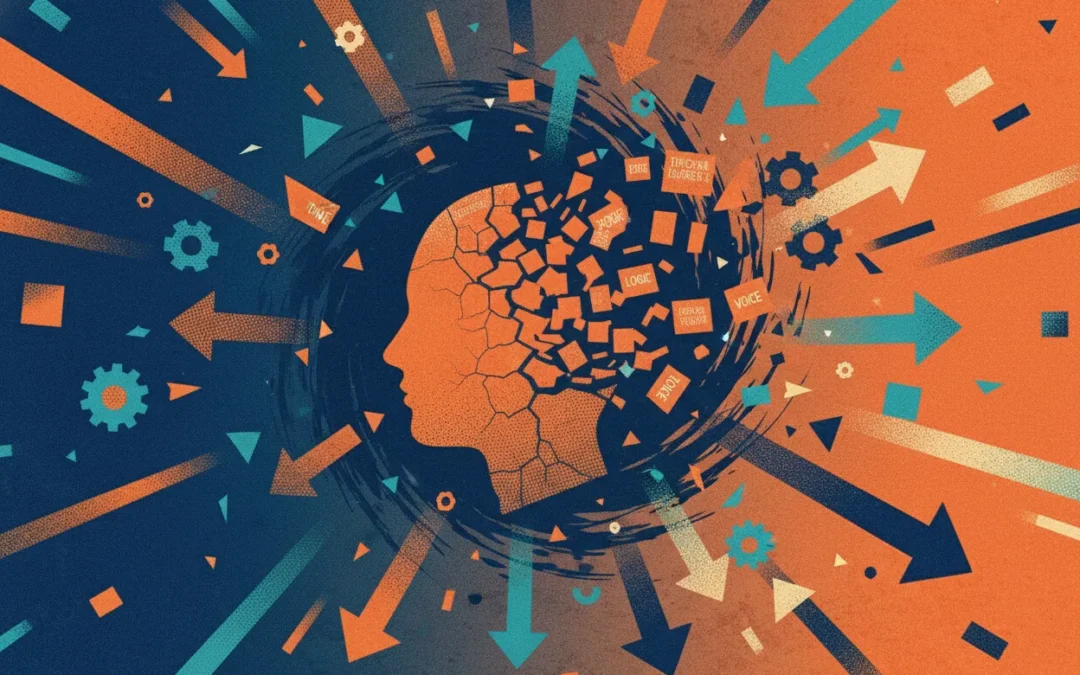
For many people, AI still carries the sensation of novelty. For power users, that novelty has matured into something more demanding, because sustained use reveals a different reality that emerges only under scale.
The intelligence is present, and the speed remains impressive. However, as AI becomes embedded in daily workflows, a quieter form of fatigue appears. Projects begin to scatter across threads, voice consistency weakens over time, and core concepts lose continuity as conversations extend.
These patterns surface regardless of discipline. Writers, educators, designers, developers, and content teams encounter the same structural tension once their work depends on reuse rather than one-off output. Research consistently indicates that the issue is not capability. The issue lies in the absence of a persistent working structure that allows thinking to remain intact across time.
Where Advanced AI Work Starts to Fray
Advanced users rarely complete meaningful work in a single session. Most projects unfold across days or weeks, requiring continuity of logic, tone, and intent. AI interfaces, however, treat each session as an isolated event, which introduces friction as work accumulates.
As a result, insights disperse across threads, architectural decisions require repeated explanation, and context must be reintroduced manually. Constraints that were once clear need to be restated simply to remain active. Over time, the experience shifts away from collaboration and toward continual reorientation.
This pattern imposes a cognitive tax. Attention moves away from the work itself and toward maintaining alignment, which changes the user’s role from thinker to overseer.
When Instructions Lose Their Grip
Power users approach AI with specificity. They define tone, structure, logic, audience, and constraints carefully because these details determine whether work remains usable across iterations.
As projects extend, however, alignment weakens. A minor deviation early in a session influences later reasoning, causing tone to drift and structural logic to soften. Although these shifts are often caught and corrected, each correction reduces confidence in the system’s ability to hold state.
Over time, this instability conditions users to supervise rather than collaborate, increasing friction precisely where momentum should compound.
How Voice Gradually Dissolves
One of the most consistent observations among advanced users concerns voice. The issue is rarely inaccuracy. The issue is flattening.
As output accumulates, language begins to settle into familiar patterns that prioritize safety and predictability. Cadence becomes uniform. Transitions become overly explanatory. Structural rhythm stabilizes at the cost of distinctiveness. The human imprint that signals authorship becomes increasingly faint.
This erosion carries real consequences in fields where authority depends on voice continuity. In marketing, education, and thought leadership, recognition and trust rely on tonal consistency that survives repetition.
Power users are not seeking impressive phrasing. They are seeking recognition of their own voice within the work.
When Review Becomes the Job
In professional environments, AI alters responsibility rather than removing it. Drafts require verification. Subtle inaccuracies demand careful review. Plausible errors carry higher risk than obvious ones because they blend seamlessly into otherwise competent work.
As a result, users become responsible for validating content they did not originate, assuming liability without authorship. Over time, this shifts effort away from creation and toward oversight, producing fatigue where efficiency was expected.
Why Prompting Feels Like It Reaches a Ceiling
Experienced users understand prompting. They refine instructions, layer constraints, and iterate carefully. Initially, this produces improvement.
As complexity grows, however, longer prompts introduce diminishing returns. Key instructions lose salience, alignment weakens, and compliance becomes localized rather than systemic. Control increases while coherence declines.
This pattern does not reflect a lack of skill. It reflects the limits of prompting as a mechanism for maintaining long-term structure.
Why These Conditions Persist
Research points to a structural mismatch between how AI systems operate and how professional thinking unfolds.
Most AI tools function through turn-based interaction, while sustained work depends on continuous reasoning across time. Large context windows expand capacity but do not provide working memory. Safety tuning favors neutral phrasing. Reinforcement processes smooth language until distinctiveness fades. Tool ecosystems remain siloed, preventing continuity from moving cleanly across environments.
The result is performance that feels strong in moments yet fragile under duration.
Power users compensate through external memory files, modular persona stacks, cross-tool verification, and manual pruning. These adaptations demonstrate ingenuity, but they also reveal what the system itself does not provide.
How Power Users Are Reorienting
As these patterns accumulate, advanced users increasingly seek environments that support thinking rather than isolated output.
They look for systems that maintain constraints, preserve voice across reuse, reduce cognitive management, and allow understanding to deepen instead of resetting. The shift moves away from individual prompts and toward architectural coherence.
This is the context in which Authentic AI operates, not as a collection of features, but as a structural layer designed to hold reasoning steady over time.
How Authentic Ai Supports Sustained Work
Authentic AI systems function as instructional frameworks that shape behavior across sessions rather than controlling individual outputs.
Each system addresses a specific structural failure that emerges during professional use.
Digital Marketing, Email & Social Media
This system maintains tonal consistency, cadence, and emotional intelligence across platforms and frequency, allowing brand voice to remain recognizable as volume increases.
Long-Form Writer
This system supports accumulation, narrative pressure, and idea completion, allowing complex writing to develop through continuity rather than fragmenting into disconnected sections.
Educational Writer
This system enables rigorous explanation that unfolds through connected reasoning, preserving authority while remaining readable without collapsing into outline logic.
SEO, GEO & LLM Web Builder
This system aligns human comprehension with machine interpretation, producing architectures that remain legible to search engines, AI systems, and readers simultaneously.
Video & Podcast Creation
This system maintains narrative continuity and tonal stability across episodic formats, supporting spoken delivery that remains coherent over time.
Artwork & Design
This system preserves visual language, aesthetic identity, and stylistic intent across formats, tools, and generations.
Together, these systems reduce managerial overhead by replacing repetition with structure.
The Bundle: When the Work Requires a Team
The Authentic Ai Bundle brings every system together, along with two additional layers designed for advanced users: the 80/20 Agent Builder and Market-Facing Visual Intelligence. Together, they function as a coordinated team rather than a single generalized assistant.
The 80/20 Agent Builder
The 80/20 Agent Builder enables the creation of agents that represent your core customer archetypes as reasoning entities. These agents surface priorities, objections, and decision logic that help pressure-test ideas before release.
When integrated with writing, education, SEO, or video systems, these agents allow work to address real audiences with clarity and precision.
Market-Facing Visual Intelligence
Market-Facing Visual Intelligence supports assets that determine whether work receives attention. It specializes in thumbnails, book covers, and visual hierarchies that communicate signal quickly and clearly.
For creative professionals, this system often becomes a source of cognitive re-entry. During moments of frustration or stagnation, visual consultation frequently unlocks alternative pathways that language alone does not provide.
Modern creative work increasingly operates through hybrid augmentation, where language, structure, and image inform one another continuously. This system supports that mode of thinking directly.
Working as a Team Inside ChatGPT
Within ChatGPT Plus, each Authentic AI system can be brought into a shared project workspace and consulted independently. Systems can operate lightly “Please check with SystemName” for reference or fully within the active thread with “@SystemName”.
This structure allows work to progress through analysis, exploration, refinement, and validation while remaining anchored to the same underlying logic. Momentum no longer depends on maintaining a single cognitive state.
The outcome is fewer passes, fewer corrections, reduced maintenance, and content that holds together as it scales.