A brief field guide to content that looks finished but means nothing
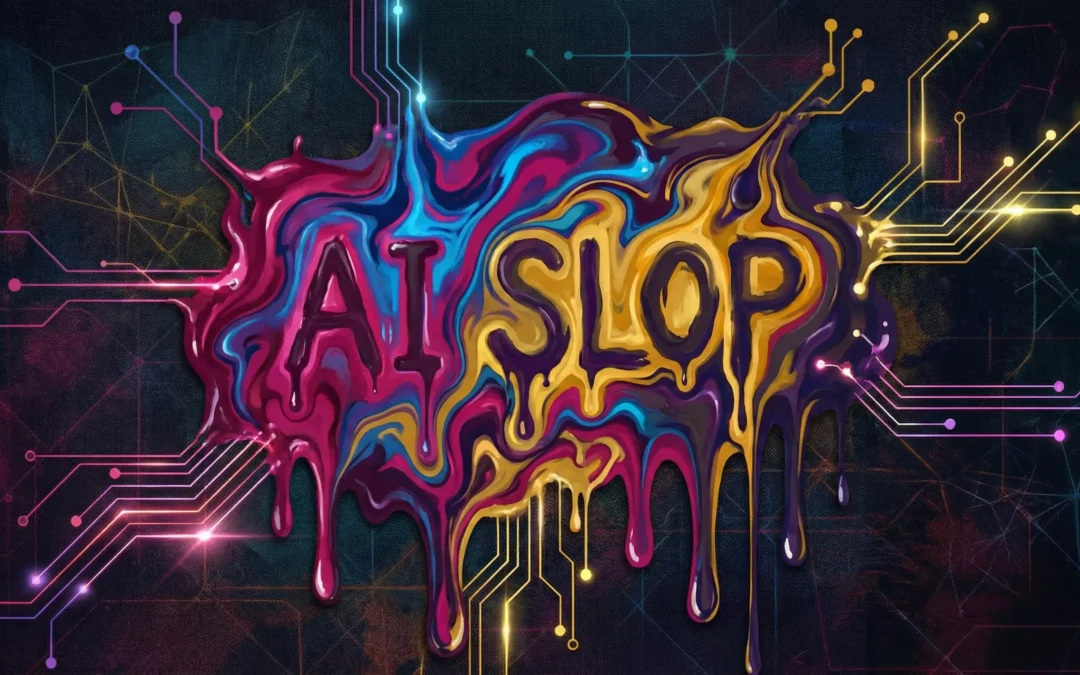
AI slop is not hard to spot, even though people struggle to define it.
You click, you skim and you realize the article is saying absolutely nothing and you have seen this content 100 times before. Somewhere between the third subheading and the seventh perfectly reasonable sentence, your brain quietly exits the room. Nothing moved you. Nothing compelled you to stay or asked you for more thought.
That is AI slop.
A working definition, because “vibes” are not enough
AI slop is output that satisfies surface expectations while avoiding meaning.
It is writing that sounds complete without having gone anywhere. Art that looks intentional without having committed to an idea with interchangable parts from one generation to the next. This content fills space, meets specs, clears checks, and leaves zero residue in the mind.
Slop is not low quality in the obvious sense. Typos can be fixed. Hands can be corrected. (Frankly, sometimes I find the real beauty is in the errors. Check out my art gallery here)
Slop is when no choice was made, no friction exists. Nothing asked anything of your mind.
Why slop feels familiar even when you cannot explain it
Your brain recognizes slop faster than your eye does, and it checks out.
You feel it when every paragraph politely explains what the last paragraph already explained, just with new synonyms. You can almost feel the word count ticker cranking away just to add some additional words and you feel it when an image looks impressive until you realize you have seen the same image, a hundred times this week.
Slop anesthetizes you.
And the truly impressive part is that it often does this while sounding “smart” and looking pretty.
The uncomfortable truth: AI slop is collaborative
It would be very comforting to blame the machines.
Unfortunately, slop is co-produced.
AI learned to do this because we taught it that this was acceptable. We asked for “a quick version” and then another quick version and then one more tweak until nothing sharp remained.
Slop is what happens when effort becomes optional and standards are never enforced.
There is no villain required.
The slop cycle
It usually goes like this:
You are tired. You need something done. You ask AI for help. It gives you something that looks usable. You sense it is hollow, but you are late, so you accept it. Later, you feel vaguely embarrassed by it, though nothing is technically wrong. You tell yourself you will fix it next time.
Multiply this by millions of people, across writing, design, branding, strategy, and art.
Slop is what happens when nothing is at stake
Here is the real diagnostic test:
If an image could be swapped with five others without altering its meaning, same problem, you are in slop territory.
Meaning requires exclusion and risk. Something has to be disallowed for something else to matter. Slop is what happens when every option stays open forever.
It is content with no cost.
The system that ended my tolerance for slop
I got tired of fixing outputs that were grammatically fine and intellectually empty. Tired of content that explained everything and resolved nothing.
So the system has one governing idea. One spine. From there, every section must narrow the field. Every paragraph must close an escape hatch. Pressure is introduced and not allowed to leak out through reassurance, repetition, or filler.
If an image exists only to be pleasant, it drifts. If it references everything, it says nothing. If it borrows style without submitting to intent, it decorates rather than communicates.
Pretty is not enough. Clever is not enough. Finished is not enough.
About “fine AI writing” and why the phrase almost works
People sometimes ask what to call this. Fine AI writing. Fine AI art. High-integrity AI. Post-slop AI.
The label matters less than the instinct.
What people are responding to is the sensation of work that could not have been produced casually. Work that feels like it passed through resistance. Work that did not let the system off the hook and did not let the user stray either.
That sensation is structural.
The future is not anti-AI. It is anti-slop.
The coming divide will not be between people who use AI and people who do not.
It will be between people who allow AI to lower their standards and people who force AI to meet them.
One group will produce endless content that looks right and disappears on contact. The other will produce fewer things that actually hold.
AI slop feels funny until you realize how much of the cultural landscape it already occupies.
Ending it does not require better taste.
It requires systems that do not permit escape.