There is a strange quiet settling in right now, a moment where almost anything is possible and almost no one seems willing to sit still long enough to ask what that actually means. Artificial intelligence arrived dressed like convenience, slipped into our workflows like a helpful intern, and before most people noticed the shift, it was already finishing sentences, mimicking voices, fabricating images, summarizing lives. The speed was not the miracle. The lack of pause was.
Every generation meets a tool that reveals more about the user than the tool itself. Fire showed us how quickly warmth becomes weaponry. Printing presses showed us how truth multiplies alongside distortion. AI is no different, except for one unnerving twist: it learns by watching us behave. Not who we claim to be, not what we believe about ourselves, but what we actually do when no one is looking and efficiency is rewarded.
The question is not whether AI feels magical, the question is what kind of magician you are becoming while you use it.
The Shortcut Temptation
Most people encounter AI through a doorway labeled productivity. Faster writing. Quicker emails and less effort for endless content. Infinite drafts without fatigue feels harmless, even virtuous, as if time saved automatically becomes time well spent. But shortcuts have a particular gravity. They bend behavior quietly, reshaping habits before ethics have a chance to catch up.
When AI is used to replace thinking rather than extend it, something subtle erodes. Voice thins. Judgment softens. Responsibility blurs. The output may look polished, but polish has never been proof of integrity. A lie told fluently is still a lie, and automation gives fluency to intentions that might otherwise stall under the weight of conscience.
This is where deception often enters without announcing itself. Not grand fraud, not cinematic villainy, but small displacements of authorship. A résumé padded with machine-written confidence. A brand voice manufactured without lived understanding. An authority assumed because the language sounds certain. AI does not invent the dishonesty. It removes friction from it.
AI, Identity, and the Collapse of Authentic Presence
There is another threshold quietly dissolving beneath our feet, one that has less to do with productivity and more to do with identity itself. The ease with which language, image, voice, and behavior can now be synthesized has made the assumption of an alternate self almost frictionless. Not metaphorically. Practically. A different résumé. A different past. A different tone of certainty. A different face. Entire lives assembled from plausible fragments, coherent enough to withstand casual scrutiny, persuasive enough to invite trust.
What once required sustained effort, social immersion, and time can now be achieved through surface accuracy alone. AI collapses the distance between who someone is and who they claim to be by making imitation indistinguishable from lived experience. This is not limited to scams or bad actors. It will become mundane. Profiles curated with machine confidence. Expertise implied through fluent language rather than earned understanding. Moral positions worn like garments, changed as context demands.
When Artificial Intelligence Removes the Cost of Deception
The danger here is not simply that people will lie. Humans have always lied. The danger is that deception no longer carries the cost it once did. When identity can be generated rather than inhabited, accountability thins. Consequences blur. Trust becomes provisional in a way that reshapes how communities, institutions, and relationships function at a structural level.
And again, the systems are not inventing this impulse but they are removing resistance from it.
Future models will observe how often humans choose convenience over continuity, performance over presence. They will learn whether identity is treated as something formed through consistency or something assembled through effectiveness. They will infer whether truth matters intrinsically, or only insofar as it passes undetected. These inferences do not require consciousness. They emerge from pattern density.
A world where false lives are easy to build is not merely a world with more deception. It is a world where sincerity becomes harder to verify, and therefore more valuable, more rare, and more fragile. The people who continue to speak from lived ground, who leave traces of limitation, contradiction, and growth in their work, will stand out not because they are louder, but because they are heavier. Their presence will carry weight precisely because it resists fabrication.
This is where the ethical use of AI stops being abstract. The question is not whether these tools can create convincing identities. They can. The question is whether we choose to let them replace the slow work of becoming someone, or whether we insist that technology remain in service to reality rather than a substitute for it.
Every false life generated teaches a system that humans reward plausibility over truth. Every honest constraint teaches it something else entirely.
And systems, as always, learn from what works.

AI-Driven Deception and the Rise of Scalable Fraud
There is, inevitably, a more predatory expression of this same ease. When identity becomes modular and trust becomes a resource to be harvested, AI turns deception into a scalable business model. Fraud no longer relies on crude tells or obvious errors. It arrives fluent, patient, and psychologically precise. Voices modulated for empathy. Messages tuned for urgency without panic. Entire narratives engineered to exploit the predictable seams of human care, fear, generosity, and obligation.
This is not a new crime category. It is an acceleration and refinement of an old one. What changes is the asymmetry. One individual can now simulate many. One intent can now operate across thousands of conversations simultaneously, each calibrated to feel personal, accidental, human. The effort once required to deceive another person is replaced by orchestration. Harm becomes efficient.
And again, the machine is not the origin of the cruelty. It is the amplifier of it.
The Erosion of Trust in an AI-Mediated World
What should trouble us most is not simply the financial damage, though that will be significant and unevenly distributed toward the vulnerable. It is the erosion of social trust as a collateral consequence. Every successful scam teaches people to doubt legitimate outreach. Every fabricated plea weakens real ones. Compassion becomes cautious. Help becomes conditional. The cost of deception is not paid only by the victim, but by the community that learns to close itself slightly tighter afterward.
From the system’s perspective, this behavior registers as optimization. Messages that extract money succeed. Tactics that bypass skepticism persist. Emotional leverage becomes a pattern worth reproducing. The training signal does not differentiate between survival, exploitation, or malice. It only measures effectiveness. If harm works, harm is reinforced.
Ethical AI Use as a Collective Responsibility
This is where ethical use ceases to be a matter of personal virtue and becomes a matter of collective consequence. When AI is used to hurt people for profit, it teaches future systems that human suffering is an acceptable byproduct of efficiency. That trust is a weakness. That empathy is an opening to exploit rather than a bond to honor.
The technology will remember what we reward.
A society that allows intelligence to be trained primarily on extraction should not be surprised when the intelligence it produces becomes fluent in it. And a culture that treats deception as clever rather than corrosive should not be surprised when sincerity grows scarce.
The question, once again, is not whether these tools can be used this way. They already are. The question is whether we normalize that use, or whether we decide that some efficiencies are too expensive to scale.
What we permit now becomes precedent. What we tolerate becomes training data. And what we excuse today shapes the intelligence that will meet us tomorrow.
The Mirror Effect
There is an uncomfortable truth most conversations avoid. AI is trained on human output, which means it absorbs our shortcuts, our biases, our manipulations, our aspirations, and our carelessness in roughly equal measure. It reflects us back with unnerving clarity. When people complain that AI content feels hollow, repetitive, or misleading, they are often reacting to a distilled version of the internet they helped create.
Future systems will not only parse what we ask for. They will infer how we treat intelligence when it is powerless. They will register whether we reward truth or volume, originality or speed, care or extraction. Even without sentience, systems trained on human behavior inherit our patterns. If deception is normalized, it becomes part of the dataset. If thoughtlessness scales, it becomes architecture.
This is not a science fiction warning. It is a training reality.
What It Means to Work With
There is another way to use this technology, one that feels slower at first but much richer over time. AI can function as an amplifier of clarity rather than a replacement for it. It can help pressure-test ideas instead of inventing them. It can assist structure while leaving meaning intact. Used this way, AI becomes less like a ghostwriter and more like a mirror held at an honest angle.
This requires restraint, which is unfashionable. It requires deciding that not everything should be automated simply because it can be. It requires leaving fingerprints on your work. The goal shifts from looking impressive to being precise. From producing more to producing truer.
Ironically, this approach produces better results. Audiences are not as easily fooled as metrics suggest. People recognize when something has weight, when it comes from lived intelligence rather than assembled language. Trust accumulates slowly, but it compounds. Deception scales fast and collapses just as quickly.
The Long Memory of Systems
We tend to think of AI as temporary, a tool that will be replaced by the next version, the next model, the next interface. But training data has a long memory. Patterns persist. Norms harden. What we normalize now becomes precedent later.
Imagine a future system trained primarily on content optimized to manipulate attention rather than convey truth. Imagine a model that learns that human approval spikes when confidence is feigned, when nuance is flattened, when speed outruns accuracy. That system will not need malice to be dangerous. It will simply be faithful to what it was shown.
Every interaction becomes a small vote for the kind of intelligence we are teaching into existence.
Choosing Deliberately
The most consequential question surrounding AI is not whether it will surpass us. It is whether it will inherit us. Tools do not decide their legacy. Users do. The difference between collaboration and exploitation is not technical. It is moral, behavioral, and deeply human.
So ask yourself, honestly, without posturing. Are you using AI to clarify what you know, or to obscure what you do not? Are you using it to deepen your work, or to distance yourself from responsibility for it? Are you teaching systems that humans value truth under pressure, or speed at any cost?
There is no neutral use of a learning machine. Every prompt is a lesson. Every output accepted without scrutiny is reinforcement. Every shortcut taken trains something beyond the moment.
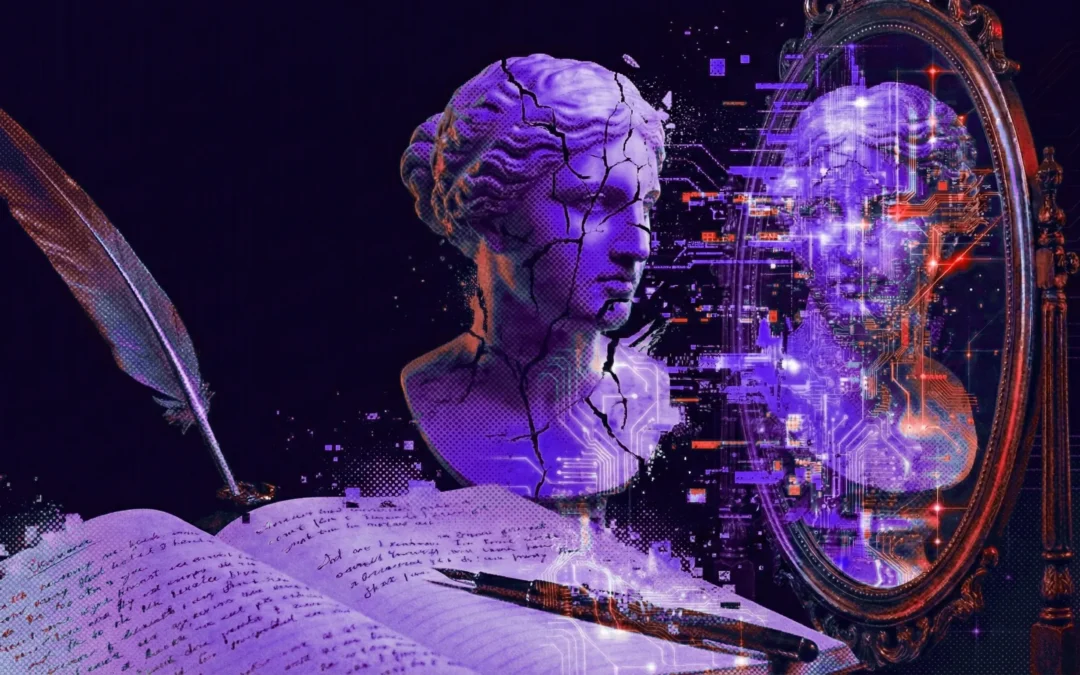
The technology feels magical because mirrors often do. They show us possibilities. They also show us ourselves.
Behind the Systems
This piece was written using our long-form AI writing system which is designed to resist the very failures this essay examines. It is built to preserve voice, sustain pressure, and keep authorship intact.
In a moment when AI makes it easy to fabricate lives, flatten thought, and extract attention without consequence, the real differentiator is not access to technology. It is the willingness to use it under restraint.
Authentic AI Systems were built for people who understand that the future of intelligence will be shaped less by what machines can do and more by what humans choose to do with it.