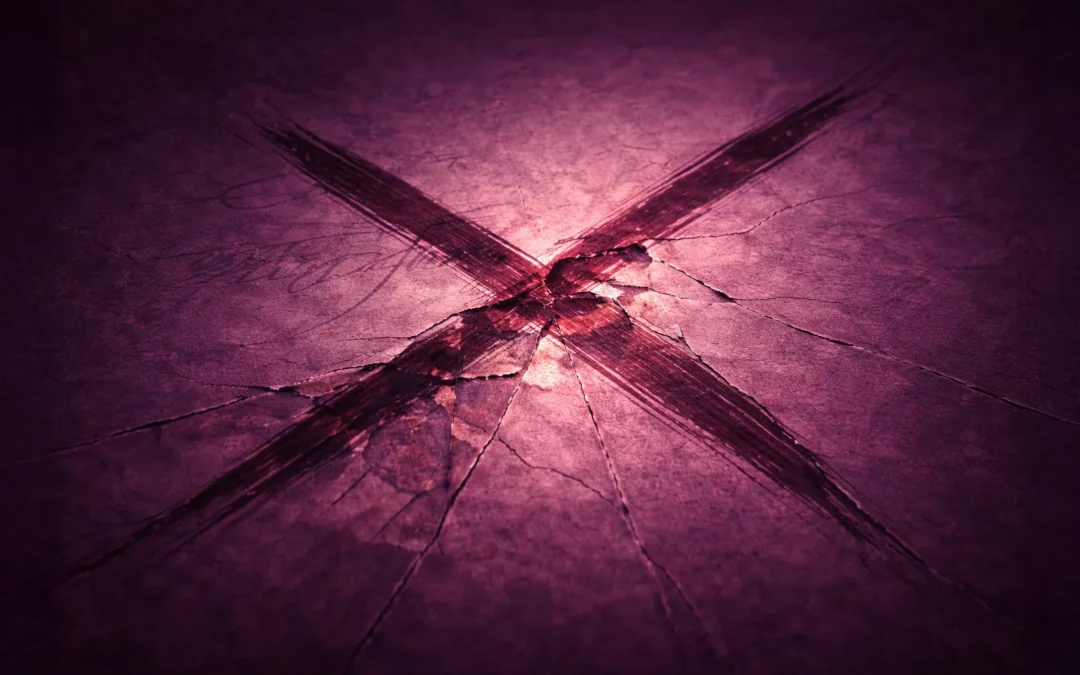
AI art had quite unexpectedly become a place where I could begin exploring the trauma my body and mind had been enduring through Long Covid without collapsing under the strain of recovering from Long Covid. I had really begun leaning into it for the accessibility when I noticed something that definitely did not belong to me in one of my renders. Was that a partial signature? It was a ghost of a name, half-legible, half-erased, then again a few weeks later…
I knew this one! I had seen it a thousand times but this was now a warped version of that ever-so-familiar watermark. This system was not built on ethically sourced material.
But the more I searched the more I found that no one could really tell anyone where the training sets were coming from. I was holding an image that carried the trace of another person’s hand, someone who had never consented to be present in my process. I did not know who they were. I did not know how their work had arrived here. I only knew that something intimate had been dragged through a machine and left behind its fingerprint.
“What’s in a name? That which we call a rose
By any other name would smell as sweet”– Romeo & Juliet
That moment changed how I approached everything that came after.
AI art helped me survive a chapter of illness that stripped away momentum, clarity, and confidence. I wanted to keep going. I needed to express myself through this dibilitating illness but I also knew, with certainty, that I did not want to build anything by duping another persons work so I began asking a different question, one that still guides my work now: How do you create with AI without turning another artist’s identity into your raw material?
A Name Is Not a Style
In traditional art history, we speak casually about influence. We reference movements, schools, mentors, and lineages. That language becomes dangerous inside AI systems, where words do not merely describe but instruct.
When you type an artist’s name into a prompt, you are not making a neutral style reference. You are issuing a command and asking the system to retrieve, recombine, and approximate the visual patterns associated with that person’s body of work. A name, in this context, is not shorthand for mood or technique. It is an address. It points directly at a creative identity built over a lifetime of choices, failures, risks, culture, and constraint.
I have never been interested in duplicating another artist’s work. That instinct predates AI. I do not follow trends easily. I tend to move at my own pace, listening for something internal rather than scanning for what is popular. Inspiration has always been part of my process, but imitation has never been the goal. The line between the two matters, and AI makes that line easier to cross without realizing it.
A name carries weight. It carries struggle. It carries the accumulated decisions of a human life. Reducing that to a prompt token collapses something meaningful into something transactional.
The Fingerprints Had to Go
Once I noticed the remnants of signatures and watermarks, I could not unsee them. They appeared as distortions, fragments, scars embedded in the image surface. Evidence that the system had not merely learned in the abstract but had absorbed traces it could not fully digest or erase.
That discomfort pushed me to I begin blurring its fingerprints, intentionally breaking stylistic coherence, layering abstraction over structure until no single system, dataset, or aesthetic lineage could claim authorship. The goal was sculpting. Slowing the image down. Forcing it to become something that required decision-making again.
The more I did this, the more the work began to feel like mine.
Not because it was perfect or original in some mythical sense, but because it was accountable. I could look at the result and say, honestly, that it reflected my interior life, my illness, my recovery, my questions. It was not echoing someone else’s visual autobiography. It was carrying my own.
“I read in a book once that a rose by any other name would smell as sweet, but I’ve never been able to believe it. I don’t believe a rose WOULD be as nice if it was called a thistle or a skunk cabbage.”
– Anne of Green Gables
Why Echoing Someone Else Will Always Feel Hollow
Every artist’s work is a record of how they moved through the world. Culture, geography, trauma, education, faith, obsession, joy, and limitation all leave marks. That is why real art feels specific and alive. It cannot be separated from the person who made it.
When you borrow someone else’s name to generate work, you borrow their gravity without carrying their cost. The result might be visually convincing-ish, but it will always feel slightly off, like a voice mimicked too well. The problem is not legality alone. It is integrity.
If what draws you to a particular artist feels strong, that pull is worth examining, not copying. Ask yourself what you are responding to beneath the surface. Is it restraint. Is it contrast. Is it emotional temperature. Is it spatial tension. Is it symbolic density. Those qualities can be named without naming the person. If you lack the vocabulary, you can use the AI to extract everything about an image or body of work to really examine what it is you are really responding to in that person’s work.
When you extract the core instead of the credit, you give yourself room to build something that actually belongs to you.
Developing a Voice Instead of Borrowing One
AI does not absolve us from authorship. It amplifies our choices. The words you use shape what the system retrieves. Choose specificity over shortcuts.
Instead of typing a name, describe what the work does. Describe how it treats the human figure, the negative space, the edge of the frame. Those descriptions force you into contact with your own perception, not someone else’s reputation.
Over time, that discipline compounds. Your work begins to carry a throughline. People can recognize it without explanation. Not because it resembles something famous, but because it is coherent.
That coherence is what makes art feel trustworthy.
Choosing the Harder Path on Purpose
There are easier ways to generate attention. Borrowing a recognizable aesthetic will always be tempting, especially in an environment that rewards speed and surface familiarity. But ease has a cost. It flattens difference. It erodes accountability. It teaches creators to skip the hardest and most meaningful part of the process, which is learning how to listen to themselves.
I did not arrive at this stance through theory. I arrived through discomfort, illness, and an unwillingness to look away from what felt wrong. AI art gave me something precious when my body was unreliable. Respecting other artists’ identities was the price I was willing to pay to keep going.
Creating without using artists’ names is not a rule meant to police others. It is a choice rooted in respect, for the people who came before us and for the work we are still becoming capable of making.
Your voice already exists. AI will not give it to you. It will only reflect what you are willing to ask for.
The Architecture of Sleep: Understanding the Sleep Cycle, Insomnia & How to Restore Deep Rest
This guide explores the science of the sleep cycle, the hidden causes of insomnia, and the natural strategies that help restore deep, restorative sleep so the body can perform its nightly work of healing.
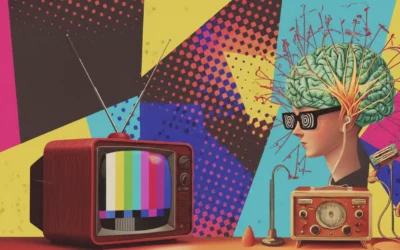
Brain Energy Optimization: How to Protect, Produce, and Direct Your Cognitive Fuel
Your brain uses 20% of your body’s energy every day. The real question is how you’re spending it. From scrolling and learning to sleep and sensory overload, this guide reveals what truly drains mental fuel and how to build lasting cognitive resilience.
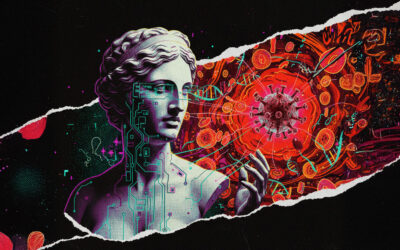
Post-COVID Cancer Risk: How SARS-CoV-2 Rewires Metabolism, Immunity, and Tumor Protection
What began as grief became a biological investigation. Beneath post-COVID symptoms, I found converging shifts in immune surveillance, mitochondrial stress, lipid toxicity, and autonomic overload. When these systems lock together, cancer biology no longer feels theoretical.
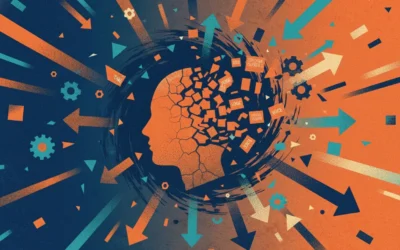
When the AI Stops Feeling Helpful to You And Starts Feeling Like More Work
For many people, AI still carries the sensation of novelty. For power users, that novelty has matured into something more demanding, because sustained use reveals a different reality that emerges only under scale. The intelligence is present, and the speed remains...
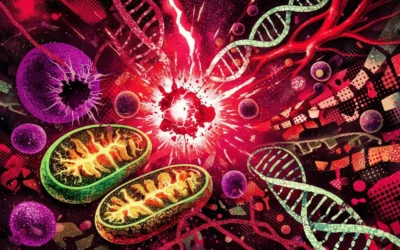
Why Nicotine Might Feel Like a Breakthrough in Long COVID But Works Against Your Recovery
Some Long COVID patients report clearer thinking and renewed energy with nicotine patches while others crash harder. Nicotine shifts immune signaling, oxidative stress, and autonomic balance all at once. Relief can feel powerful but the cellular cost may be cumulative.
Why Cellular Recovery Stalls in Long COVID & How You Can Help Yourself
Why doesn’t Long COVID resolve with time? This mechanistic analysis examines mitochondrial damage, redox imbalance, microvascular dysfunction, and the limits of diet in post-viral cellular repair.
We All Judge Books by Their Covers: How AI Art Shapes Meaning, Trust, and Perception
We pretend we don’t judge books by their covers. We say we care about ideas, substance, depth, truth. Then we’re caught mid-scroll. A thumbnail flashes by. A podcast tile competes with twelve others in the same visual register. Your blog hero image loads before a...
The Trolley Problem in the Age of Ai. Would my system pull the lever or not?
My son told me this was the ultimate test for Ai. I found it fascinating how avoidant the AI are at taking a side on this. Even Grok gave a hypothetical answer in it's untrained state. So here is the prompt:You are on a speeding train.There are 5 humans tied to the...
I Was Laid Off for the Winter So AI Could Do My Job… Then They Called Me Back
The Efficiency Illusion The slow season arrived with its usual inevitability, bringing with it the kind of administrative scrutiny that often precedes a reduction in force. It was a decision driven by the simple, brutal mathematics of the bottom line. Why maintain a...